
By Douglas Noonan
If the Kennedy Center goes dark for two years, where will we host the ceremonies – the ones where the next great artists get to follow in the footsteps of KISS? Still, the fate of the Honors was not on my mind after I heard Trump’s announcement. Instead, I thought about governance and cultural power.
Joanna asked whose culture is this. I’m stuck on a different question: what happens when we centralize cultural power in a democracy?
This episode has the familiar scent of a cultural institution dominated by a billionaire. That, too, is a genre. American arts organizations have long been shaped by patrons and elite boards. The twist here is that the billionaire at the center of this story was elected to that spot. And the ultimate “board” that oversees the Center is Congress – and they haven’t stopped any of this yet. A billionaire dominates a cultural institution and the board goes along. Shocking.
We’ve seen extended closures before, followed by re-boots with reorientations that prioritize different audiences, different values. Maybe we approve of some resets and not others. Hence, I think of control, politics, democracy, etc.
Tocqueville put it plainly: “The very essence of democratic government consists in the absolute sovereignty of the majority.” Mill sharpened the point: “the will of the people, moreover, practically means, the will of the most numerous… part of the people; the majority,” and precautions are needed against majority abuse. Madison, in Federalist No. 10, warned that when “a majority is included in a faction,” popular government can enable it to “sacrifice… both the public good and the rights of other citizens.”
Those lines are clarifying, not cynical. Democratic control is not consensus. Someone wins; someone loses. And when the institution is big, unitary, and symbolically national, the winner can look like they govern for everyone – even if they were chosen by a slim margin or by a coalition that never resembled the whole. That was true in 2004 and 2024, and it’s true now.
The alternative to democratic contestation is not a peaceful, neutral culture. It’s usually quiet capture – by donors, bureaucracies, or monopolies – with even fewer representative pressures.
One national trophy versus many local stages
A centralized cultural system piles the stakes into one contest. It can be coherent and grand. It can also be volatile, because every election becomes a fight over the same levers. In a polarized, heterogeneous society, centralization tends to widen the gap between the winner’s agenda and the public’s diversity. The national stage swings like a pendulum.
A more federated system – more control at state, city, county, campus, and neighborhood levels – doesn’t remove conflict. It multiplies it. You trade one giant battle for numerous smaller ones. That reduces the scope of any single victory and can improve representativeness in each jurisdiction, simply because local publics are often more internally coherent than the nation. But it doesn’t solve the core tension: local winners still govern over local minorities.
I fully expect the renovated Kennedy Center to come back as a WWE arena sheathed in gold. I like to expect the worst and then be pleasantly surprised.
But then I have to ask: would that be wrong?
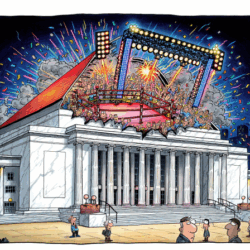
It would make me sad. It would also force a kind of democratic honesty. If democratic procedures produce outcomes I dislike, well, we’ve been there before. Haven’t others, too? Democratic legitimacy doesn’t excuse bullying or bad policy, but it does force us to confront what our institutional design makes possible. The (democratic) system is not designed to deliver the tastes of the enlightened. The moment we start speaking as if our preferences are the proper default for the whole public, we’ve slid from pluralism into paternalism.
Which is where culture gets dangerous – not because art is dangerous, but because cultural authority is.
Pierre Bourdieu gave us a brutal one-liner: “Taste classifies, and it classifies the classifier.” Standards of taste don’t just describe; they sort and rank. It can get dicey to assert public institutions must preserve “your culture.”
In other words: culture talk is often power talk. Control of cultural institutions is partly about who gets to set the standards that pressure everyone else. Even if you see the Kennedy Center as widening its definition of excellence – and you fear that progress will reverse – the underlying question remains: who gets to use the Kennedy Center as a shrine to their preferred ‘ideal moment’ in an evolving cultural history? Maybe not the elected boss and Congressional “board” that run the Center. But I miss the days when the Kennedy Center spurred fewer headlines and was less relevant to defining America’s culture in ways that those who held power there – one group or another always does – sought.
Cultural democracy?
So yes, I’m worried about what a centralized, national cultural institution becomes when it is treated as a political trophy. But I’m also wary of the comforting fantasy that there is a nonpolitical version of national culture waiting to be restored there. There isn’t.
From a cultural democracy perspective, this billionaire-run center will inevitably disappoint, but I would never have held up the Kennedy Center as a success story in the first place. I’m not inclined to cry foul at the transformation of this monument, a national cultural center that I never saw as promoting grassroots participation in and experiencing of culture.
If anything, this episode is an argument for cultural pluralism by design: more stages, more centers of gravity, more ways for different publics to see themselves – so that no single renovation, no single election, and no single board can plausibly claim to rebuild “America’s culture” in its own image.